Reverie


Reverie - n. a state of being pleasantly lost in one's thoughts; a daydream or fantasy; a visionary or impractical idea

"To make a prairie it takes a clover and one bee,—
One clover, and a bee,
And revery.

The revery alone will do
If bees are few." - Emily Dickinson
Showing posts with label hive inspection. Show all posts

Thursday, April 10, 2014

Babe, I'm Gonna Leave You.

I checked in with my backyard hive the other day, expecting to find them busily working on drawing new foundation and storing nectar. They were doing that (see above), but...


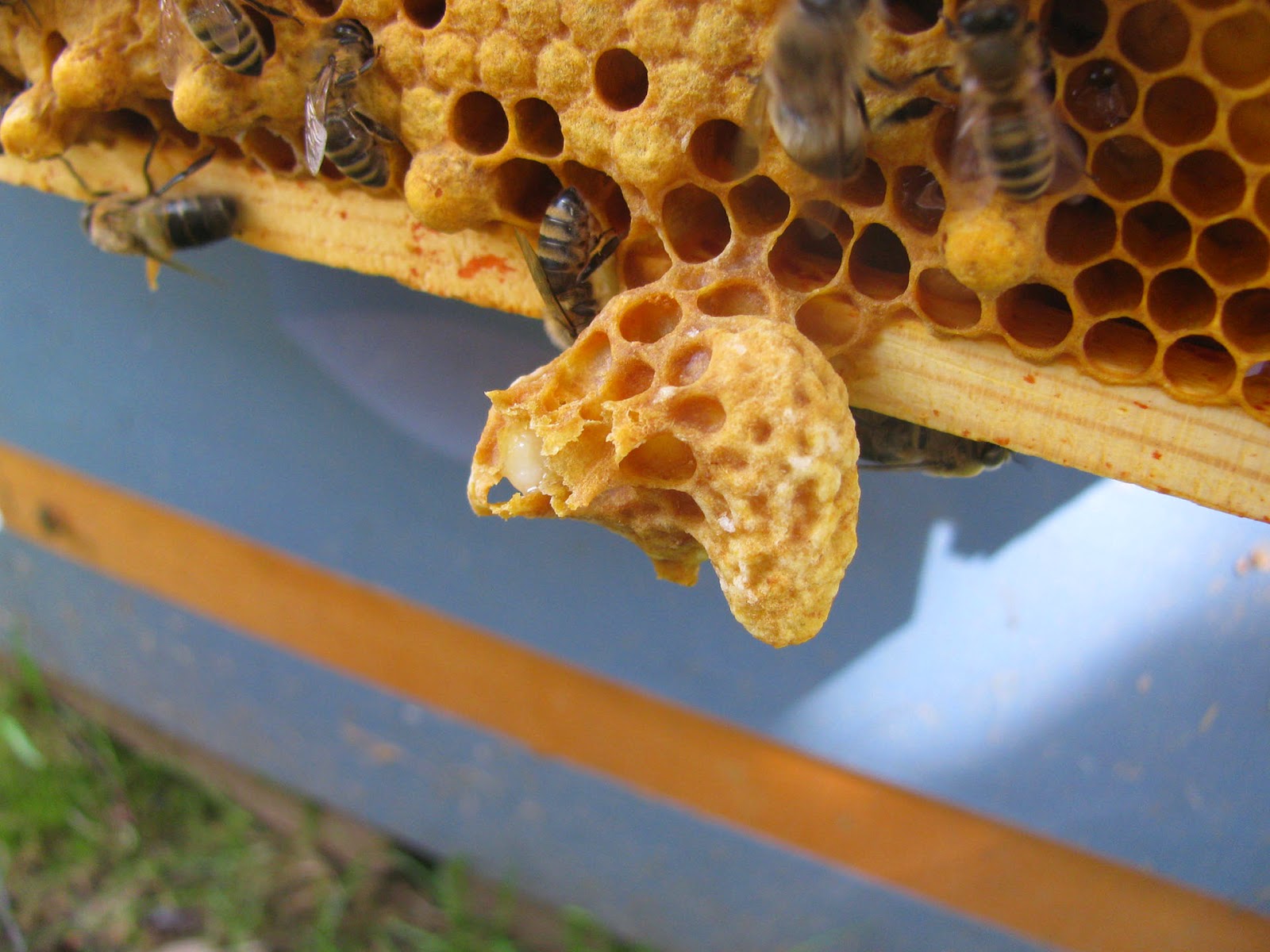
...apparently they are working on some side projects as well.  Dang!  This is the fancy pants Russian hygienic queen I bought last year.  Multiple capped and uncapped swarm cells in the middle brood box (I use all 8 frame westerns).  


Here is a queen larvae swimming in a bath of royal jelly.  And WOW, my gloves are dirty!


Here is another surprise for me.  Look closely...


Multiple varroa mites in a single drone cell.  I check the mite board on this hive regularly, and I have counted maybe one mite in the last few weeks.  But scrape open the drone cells and it's a different story.  This highlights the importance of monitoring and testing for varroa beyond just visual inspections of a mite board.  


It's not all doom and gloom though.  The bees and brood look good and they are bringing in loads of nectar and pollen.  Swarm season is upon us! I hope this queen stays.

Thursday, June 6, 2013

Luscious queens and micro-colonies

My Old Sol queen arrived today, so what better time to try out our new western nucs?  The majority of my hives are all westerns, meaning I use western hive boxes for both brood and honey supers.  The problem with this system (only ONE of many according to deep fans) is that standard deep nucs are useless if we want to make splits or keep a queen on reserve. 

First I made triple-sure the queen wasn't on a frame I was taking from the existing colony.  Look at that Italian queen.  Large and slow and sexy (isn't beekeeping great?).  You wait right here, ma'am.

I pulled a few frames of solid capped brood covered with nurse bees, shook a couple frames of extra bees in for good measure, added a frame of honey and pollen, and placed the queen cage. 

The western nuc!  And just like that, one colony becomes two, and I have a premium queen on reserve if I need her. 
 

Thursday, May 2, 2013

Exodus

Beeman moved his hives to a new location near the McDonald-Dunn Forest.  I have a little hive there, too.      
 
Today I was checking in on my virgin situation and noticed more activity than usual at the entrance to one of Beeman's hives.  His bees are usually busy on a hot day like this...


...but today they were acting weird.  Loitering, even.  And there were drones emerging, too.
 
Then they started pouring out of the hive like liquid, with the most incredible sound you can imagine. 


They kept coming, and COMING, AND COMING.

 Once in the air they appeared very disorganized. But be patient...

Bees have perfected the art of organized chaos.  Eventually a pattern to their movements became evident and I was able to determine which tree they had chosen. 

Maybe four or five minutes later, and the entrance is back to normal.  Minus a few thousand bees of course.  And the queen.  
 
They chose a tree not fifteen feet from their original hive.  Just for fun, I wanted to capture Beeman's colony and put it in my own hive. That is way too high though. 

So here they rest, clustered tightly around a branch, protecting the queen and weighing their options.  To a beekeeper swarms can be a frustration and represent a loss of hive productivity and honey-making potential. 
 
But in terms of the bees it is colony-level reproduction and a sort of cleansing ritual for the hive.  I have observed many swarms in flight, but I am still blown away that I was able to see this one come to life.   


Wednesday, April 24, 2013

The Virgin Diaries - Part I

This is what I love about beekeeping.  You never know what you're going to get when you open a hive.  In this case it was virgin queens, and lots of them. Beeman's hives are bursting at the seams, and this one seems a bit restless and unsatisfied. 

Swarm cells.  Supercedure cells.  Cells constructed and then abandoned.  Cells ripped apart by an emerging virgin queen.  Cells intact housing a virgin queen.  This hive doesn't discriminate. 

I removed a cell and opened it up out of curiosity.  There is the live queen, sitting in waxy darkness waiting to learn her fate.  She is small and unmated, with a slender abdomen not yet ready for egg-laying, and she's all mine. 

Into a queen cage she goes until we decide where to put her.  Imagine being suspended in a cage, in darkness, with thousands of others clamoring for your release, when you'll either be accepted as the future of the hive or killed on the spot.  What a game of chance.

This is the swarmy virgin-factory.  This hive is literally spilling over with bees.  Dripping, buzzing, crowded, restless bees.

I caught another live one just hatching.  In the cage you go. 

Sidenote:  to the beekeeper go the spoils.  Always reserve a taste for yourself.

Another nice queen cell.  Let's open it and collect another. 

By this time the hive has been open for a while. 

We ran out of queen cages, so for now they'll live in these jars.  When I dream of my perfect bedroom, there is an observation hive in the wall above my bed, and jars like these on shelves. 

That dark beauty is a definite keeper.  In fact, I may take her with me and make a split from my hive at home.  A virgin queen is a gamble - she has to make it out on a mating flight and then back again, but experimentation and a bit of uncertainty are the spark of beekeeping for me.

Beeman has incredible colonies.  The swarmy virgin-factory is one of his.


In all, we gathered six new queens from that hive that were healthy and strong enough to save.  Two are going with me, and four are co-habiting this nuc for the time being (two in cages and two unhatched cells).

Thursday, January 31, 2013

Death in the Afternoon

The green hive on the right was the star this year, at one point supporting THREE active honey supers.  And now it is dead. 
 
The sunny scene and busy bees distracted me from noticing what was really going on.  See those emerging bees?  They are all dead.  And the worst part?  Every single capped brood cell in this photo contains a dead bee.  This is a hive with no future.

There is a window during the late summer season when mite populations can explode in the hive.  I was busy with other events in my life and didn't take care of the bees as I should, and they paid the price for my negligence.  Lesson learned the hard way.

These are bees I pulled from brood cells for closer inspection.  The culprit is Deformed Wing Virus, a disease transmitted by Varroa mites.

Here is a young bee exhibiting the classic symptoms of the disease - distorted, twisted wings.  Compare them to the bee on the left.

What a sad realization.  Do you see the queen?  She is presiding over a hive with a death sentence.  At this time of year, the bees developing within brood cells are the ones that will see the hive through the winter. There is no new generation of bees to sustain this colony.  

To make matters worse, this was also the time of year that yellowjackets were at their most vicious, tearing into colonies and killing bees. A weakened hive struggling with disease is an easy mark.
Once I determined that this hive would not survive, I took off the honey super that was supposed to be their reserve for the winter and reduced the colony down to only two brood boxes. 

A few days later I opened the hive to silence.  Thousands of bees gone in a matter of days, and frame after frame of dead capped brood. Not a single bee, except this one. The queen was the sole survivor!  With no attendants, she was struggling to stay alive. 


Wednesday, August 1, 2012

Hive Inspection - Late July

I checked in on my hives last weekend.  They are filling up the honey supers so fast right now and I need to stay on top of it.  This is a foundationless frame that they are still drawing out.  If you look closely you can see the horizontal wiring.  They incorporate it beautifully into their comb, making it stronger for extracting.  Organic loveliness. 

They are not finished with this one yet, but I have observed that in general they make much larger communication holes on the bottoms of foundationless frames than they do when given foundation.  Do they just prefer not to waste time chewing out foundation?  Sometimes the only attachment points are on the sides of the frames, with the bottom left completely open.  Look at the beautiful orange propolis on the top bar of the frame.  That stuff is so resinous and sticky it will stay on your fingers for days.
Pulling up a really heavy, pure white frame like this still takes my breath away. Beauty in simplicity.  Yet imagine the treasure hidden beneath...
It was a tight squeeze, and this was the first frame I pulled out.  Equal parts exciting and unfortunate.  I wanted to sink my teeth into that, black bear style.
And now this....I lifted the bottom-most honey super, the one that sits directly on top of the queen excluder.  And there was a lovely sucking/pulling sound.  This is why.  I scraped up all of this, making a mess and dripping honey all over myself, the bees, and the hive.  It was an absolute honey frenzy for everyone involved.  There was probably a better way to do it, but I am a novice who always makes giant mistakes when no one is around to see.
A frame from the top brood box (below the queen excluder).  Only two frames had brood, the rest of the box was solid capped honey.  This frame is incredibly honey bound.  Look at the variety of pollen sources these bees were bringing in!  I love to see that rainbow pattern. 

By the way, there is NO WAY I would be able to lift a 10-frame box full of honey.  I'm eternally grateful I went the way of the 8-frame hive.  I would recommend them to all female beekeepers. Nothing against my fellow girls, but those things are HEAVY!
A first-year hive, from package bees, tended by a first-time beekeeper.  Wow!  Beyond all my expectations.  I must have a good mentor :)
Speaking of that, look what he gave me the other day....three full boxes worth of old, fully-drawn comb.  They need to be cleaned out by bees and tidied up a bit, but I want to set up more hives next spring and I won't turn down free equipment, no matter the condition! 
Here are the bees at work cleaning up one of those second-hand boxes for me.  Probably not a good idea to encourage robbing this time of year, but we'll see what happens.  I really do learn from making lots of mistakes.  For instance, I left the other two boxes uncovered in the garage next to my boy's bicycles with the garage door open.  MISTAKE.

Sunday, June 24, 2012

Must. Not. Taste.


I peeked in my hives today.  Just the honey supers, and just for a moment.  It's best if I leave them alone right now when they are so busy gathering nectar, but I can't help myself.  The wire grid in this photo is a queen excluder, placed between the top most brood box and the first honey super.  The bars are spaced to allow workers to pass through, but not the larger queen.  Most people prefer their honey without eggs and larvae mixed in.  Five of the eight frames in this box are full of honey already! 

These are two frames stacked next to each other.  You can see the starter strip of wax on the foundationless frame, and the wires that will reinforce the comb for use in a honey extractor.  The bees are just beginning to draw out comb on these frames.

Here is one of the second-hand frames Beeman gave me, hanging from a frame rest on the outside of the hive.  A frame rest is a bee photographer's best friend when they are working solo.  The entire frame is completely filled with honey.  I really want to taste it.

Here is a closer look.  The wax comb is older and darker than on my newer frames, so the honey appears darker.  They still have to fill the cells a bit before they cap them.  You really have no idea how badly I want to taste this. 

Here is honey being stored in newly drawn comb on a brand new frame.  The wax is white so the honey appears lighter.  Look how fuzzy and young some of the bees are.  They are taking their job very seriously.  It's taking every ounce of my almost non-existent self control not to taste this honey.  It will be worth the wait.