Monday, May 6, 2013
Thursday, May 2, 2013
Exodus
Beeman moved his hives to a new location near the McDonald-Dunn Forest. I have a little hive there, too.
...but today they were acting weird. Loitering, even. And there were drones emerging, too.
Then they started pouring out of the hive like liquid, with the most incredible sound you can imagine.
Once in the air they appeared very disorganized. But be patient...
Bees have perfected the art of organized chaos. Eventually a pattern to their movements became evident and I was able to determine which tree they had chosen.
Maybe four or five minutes later, and the entrance is back to normal. Minus a few thousand bees of course. And the queen.
They chose a tree not fifteen feet from their original hive. Just for fun, I wanted to capture Beeman's colony and put it in my own hive. That is way too high though.
So here they rest, clustered tightly around a branch, protecting the queen and weighing their options. To a beekeeper swarms can be a frustration and represent a loss of hive productivity and honey-making potential.
But in terms of the bees it is colony-level reproduction and a sort of cleansing ritual for the hive. I have observed many swarms in flight, but I am still blown away that I was able to see this one come to life.
Labels:
Beeman,
hive inspection,
swarms,
virgin queens
Wednesday, April 24, 2013
The Virgin Diaries - Part I
This is what I love about beekeeping. You never know what you're going to get when you open a hive. In this case it was virgin queens, and lots of them. Beeman's hives are bursting at the seams, and this one seems a bit restless and unsatisfied.
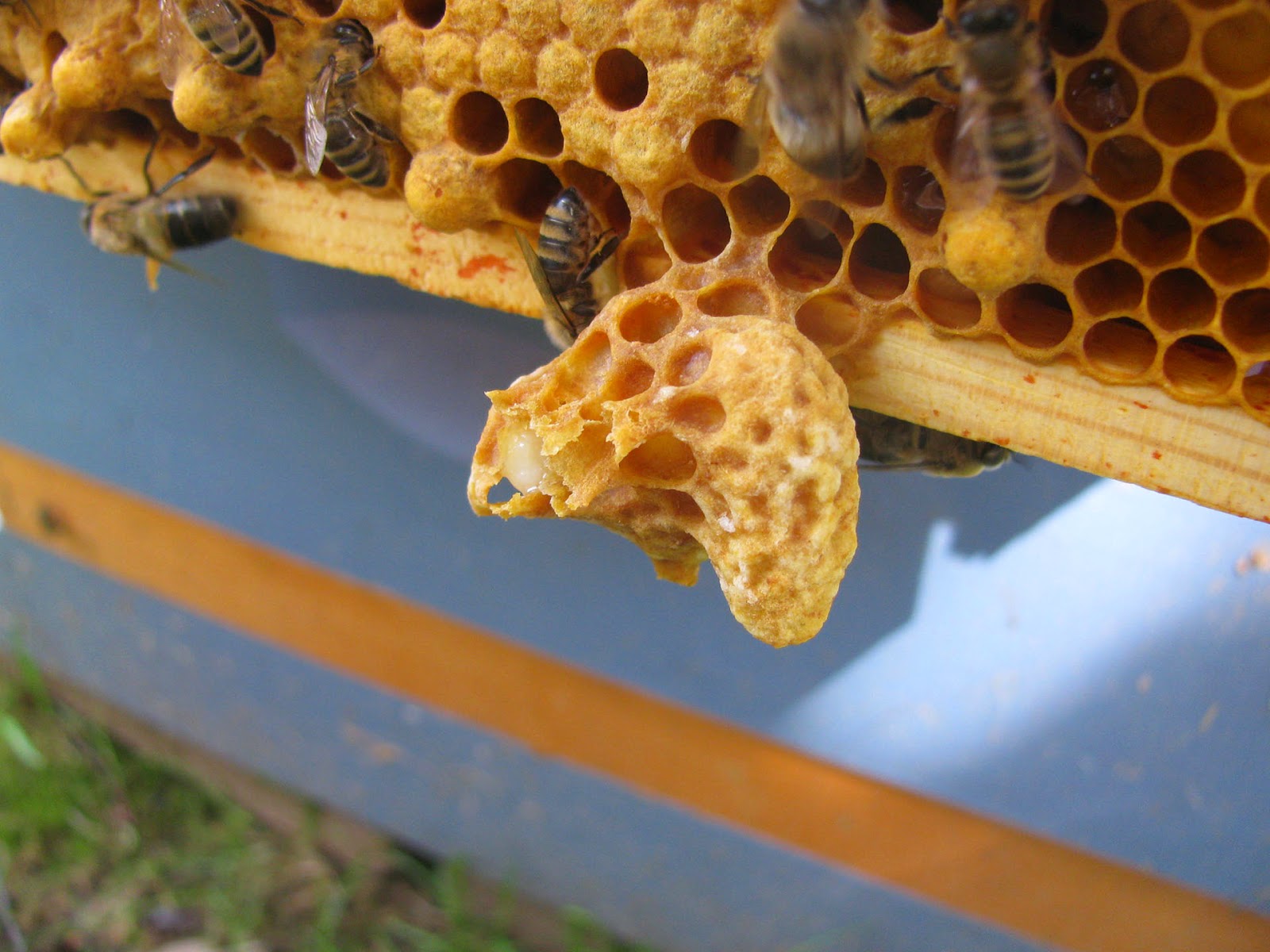
Swarm cells. Supercedure cells. Cells constructed and then abandoned. Cells ripped apart by an emerging virgin queen. Cells intact housing a virgin queen. This hive doesn't discriminate.
I removed a cell and opened it up out of curiosity. There is the live queen, sitting in waxy darkness waiting to learn her fate. She is small and unmated, with a slender abdomen not yet ready for egg-laying, and she's all mine.
Into a queen cage she goes until we decide where to put her. Imagine being suspended in a cage, in darkness, with thousands of others clamoring for your release, when you'll either be accepted as the future of the hive or killed on the spot. What a game of chance.
This is the swarmy virgin-factory. This hive is literally spilling over with bees. Dripping, buzzing, crowded, restless bees.
I caught another live one just hatching. In the cage you go.
Sidenote: to the beekeeper go the spoils. Always reserve a taste for yourself.
Another nice queen cell. Let's open it and collect another.
By this time the hive has been open for a while.
We ran out of queen cages, so for now they'll live in these jars. When I dream of my perfect bedroom, there is an observation hive in the wall above my bed, and jars like these on shelves.
That dark beauty is a definite keeper. In fact, I may take her with me and make a split from my hive at home. A virgin queen is a gamble - she has to make it out on a mating flight and then back again, but experimentation and a bit of uncertainty are the spark of beekeeping for me.
Beeman has incredible colonies. The swarmy virgin-factory is one of his.
In all, we gathered six new queens from that hive that were healthy and strong enough to save. Two are going with me, and four are co-habiting this nuc for the time being (two in cages and two unhatched cells).
Labels:
Beeman,
bees in jars,
hive inspection,
nuc,
queen cells,
swarms,
virgin queens
Monday, April 22, 2013
Wisp
The bees have woken up for the season, and so has my blog.
Everything I love about beekeeping is in this photo right here.
Thursday, March 28, 2013
Somewhere, Bees Are Flying...
On this cloudy, drizzly Oregon day it feels appropriate to post some pictures of bees flying in the sunshine, gathering nectar and pollen from exotic sources. My bees are clustered inside their hive, thinking how tired of they are of pollen patties and dampness. I won't show them these pictures.
Above, a bee pollinating a large banana flower.
A large black sweat bee on Rosemary....

Sabal palmetto inflorescences. Palmetto honey is exquisite - sweet and spicy.

Roses blooming - in early March.
Sunday, March 10, 2013
Fast Forward
I admit it. I'm a Florida girl. And this week I am back home visiting family and friends on the first solo trip I have taken in over seven years. Although I love everything about Oregon and have no plans to leave, my heart is still in Florida.
Yesterday I was in Gainesville - home of the Gators and place where three generations of my family have gone to school. And of course I went bee-hunting. I found some on the edge of the prairie...
These bees are are too busy flying over fields of flowering brassicas and strawberries to care about their comrades in Oregon, still clustered tight in their brood boxes waiting for spring. The weather here is warm and sunny and feels like a summer day by Pacific Northwest standards.
The hives are simpler too. There are no screened bottom boards, ventilated inner covers, telescoping tops and massive feeders like you need in a cool, wet climate.
Soon this southern girl will travel back to Oregon with my bag full of honey from palmetto, gallberry, and tupelo, and work to get my bees ready for spring. But I'll leave my heart here in Florida.
Live oak hammock
Go Gators!
Pine flatwoods
Old homestead oranges
Yesterday I was in Gainesville - home of the Gators and place where three generations of my family have gone to school. And of course I went bee-hunting. I found some on the edge of the prairie...
These bees are are too busy flying over fields of flowering brassicas and strawberries to care about their comrades in Oregon, still clustered tight in their brood boxes waiting for spring. The weather here is warm and sunny and feels like a summer day by Pacific Northwest standards.
The hives are simpler too. There are no screened bottom boards, ventilated inner covers, telescoping tops and massive feeders like you need in a cool, wet climate.
Soon this southern girl will travel back to Oregon with my bag full of honey from palmetto, gallberry, and tupelo, and work to get my bees ready for spring. But I'll leave my heart here in Florida.
Live oak hammock
Go Gators!
Pine flatwoods
Old homestead oranges
Thursday, February 14, 2013
Deep Breath....Now Jump!
I want to be a beekeeper.
Not just on weekends, but every day. So here I go. Introducing Nectar Bee Supply.
I am lucky to have the most amazing business partners (co-conspirators?) a girl could ever dream about in Karessa Torgerson and Melanie Sorenson. I still can't believe the events that have unfolded to bring us to this point.
There is a strong beekeeping community in Corvallis that includes lots of seasoned pros and even more beginners eager to get started. So many people in our area have talents related to beekeeping - whether they raise queens, construct ventilation boards in their garage, grow bee-friendly plants for seed, or bottle artisan honey. We want to connect all of these people and serve as a clearinghouse for that community.
The hard part is trying to balance unlimited ideas with very limited resources. We don't want to be a discount beekeeping store. We want everything we sell to be useful, durable, and beautiful.
Beekeeping equipment? Definitely. Classes and events? Absolutely. Native pollinators? We like them too. Hive hosting, a honey CSA, a community honey house, our own store...Just wait.
Keep your eyes on us, we have big ideas. Now if you'll excuse me I have to get to work.
Saturday, February 9, 2013
Invictus
Out of the night that covers me,
Black as the Pit from pole to pole,
I thank whatever gods may be
For my unconquerable soul.
In the fell clutch of circumstance
I have not winced nor cried aloud.
Under the bludgeonings of chance
My head is bloody, but unbowed.
Beyond this place of wrath and tears
Looms but the Horror of the shade,
And yet the menace of the years
Finds, and shall find, me unafraid.
It matters not how strait the gate,
How charged with punishments the scroll.
I am the master of my fate:
I am the captain of my soul.
Black as the Pit from pole to pole,
I thank whatever gods may be
For my unconquerable soul.
In the fell clutch of circumstance
I have not winced nor cried aloud.
Under the bludgeonings of chance
My head is bloody, but unbowed.
Beyond this place of wrath and tears
Looms but the Horror of the shade,
And yet the menace of the years
Finds, and shall find, me unafraid.
It matters not how strait the gate,
How charged with punishments the scroll.
I am the master of my fate:
I am the captain of my soul.
William Ernest Henley
Thursday, January 31, 2013
Death in the Afternoon
The green hive on the right was the star this year, at one point supporting THREE active honey supers. And now it is dead.
There is a window during the late summer season when mite populations can explode in the hive. I was busy with other events in my life and didn't take care of the bees as I should, and they paid the price for my negligence. Lesson learned the hard way.
These are bees I pulled from brood cells for closer inspection. The culprit is Deformed Wing Virus, a disease transmitted by Varroa mites.
Here is a young bee exhibiting the classic symptoms of the disease - distorted, twisted wings. Compare them to the bee on the left.
What a sad realization. Do you see the queen? She is presiding over a hive with a death sentence. At this time of year, the bees developing within brood cells are the ones that will see the hive through the winter. There is no new generation of bees to sustain this colony.
Once I determined that this hive would not survive, I took off the honey super that was supposed to be their reserve for the winter and reduced the colony down to only two brood boxes.
A few days later I opened the hive to silence. Thousands of bees gone in a matter of days, and frame after frame of dead capped brood. Not a single bee, except this one. The queen was the sole survivor! With no attendants, she was struggling to stay alive.
Saturday, January 26, 2013
Out of the Comb and Into the Bottle
I miss writing about bees! The world has slipped away from me these past few months, but I'm slowly finding my way back.
For those of you who bought honey from me this season, here are some photos of how that magic was extracted from the hive, poured into bottles, and placed in your mouth. Look at that photo above. Hours and hours spent working in the hive lead up to that. A heavy, dripping, crawling-with-bees frame of honey. Yes, please.
Shhhh...that's my glove in the photo! I have become fairly well-trained at judging bee temperment, and these ladies were feeling pretty hot that a bear in white clothing was messing with their honey. So on they go.
After sitting in a hot room for many days, the frames are removed from the hive box and prepared for extraction. That's an electric uncapping knife that we use to scrape off the wax cappings that seal the honey in the cells. It's very hot and melts the wax on contact.
These are frames in various stages of preparation. All heavy, all luscious, all just sitting there waiting to release their honey.
A freshly uncapped frame of honey. Look at that glowing world inside those cells. Perfection!
Thank you, Karessa, for letting me use your extractor. And your kitchen. And your hot room. Those are heating coils to keep the honey flowing.
This is the fun part - using the hand-cranked extractor to spin honey from the frames. No, those are not my arms.
After the honey is extracted, it needs to go through a strainer to remove large chunks of wax and the occasional bee wing or leg. Raw honey is the best, but it requires a bit of attention at the start.
Sticky, sticky, sticky. Everything gets STICKY.
After several levels of filtering, the honey is poured into gallon-size glass jars to sit for a few days. This allows air bubbles to dissipate and wax to collect at the top for easy removal.
Cappings wax is literally a hot mess. But think of the possibilities!
The extractor is a disasterous mess, so outside it goes to be cleaned up by the bees.
For those of you who bought honey from me this season, here are some photos of how that magic was extracted from the hive, poured into bottles, and placed in your mouth. Look at that photo above. Hours and hours spent working in the hive lead up to that. A heavy, dripping, crawling-with-bees frame of honey. Yes, please.
Shhhh...that's my glove in the photo! I have become fairly well-trained at judging bee temperment, and these ladies were feeling pretty hot that a bear in white clothing was messing with their honey. So on they go.
After sitting in a hot room for many days, the frames are removed from the hive box and prepared for extraction. That's an electric uncapping knife that we use to scrape off the wax cappings that seal the honey in the cells. It's very hot and melts the wax on contact.
These are frames in various stages of preparation. All heavy, all luscious, all just sitting there waiting to release their honey.
A freshly uncapped frame of honey. Look at that glowing world inside those cells. Perfection!
Thank you, Karessa, for letting me use your extractor. And your kitchen. And your hot room. Those are heating coils to keep the honey flowing.
This is the fun part - using the hand-cranked extractor to spin honey from the frames. No, those are not my arms.
After the honey is extracted, it needs to go through a strainer to remove large chunks of wax and the occasional bee wing or leg. Raw honey is the best, but it requires a bit of attention at the start.
Sticky, sticky, sticky. Everything gets STICKY.
After several levels of filtering, the honey is poured into gallon-size glass jars to sit for a few days. This allows air bubbles to dissipate and wax to collect at the top for easy removal.
Cappings wax is literally a hot mess. But think of the possibilities!
The extractor is a disasterous mess, so outside it goes to be cleaned up by the bees.
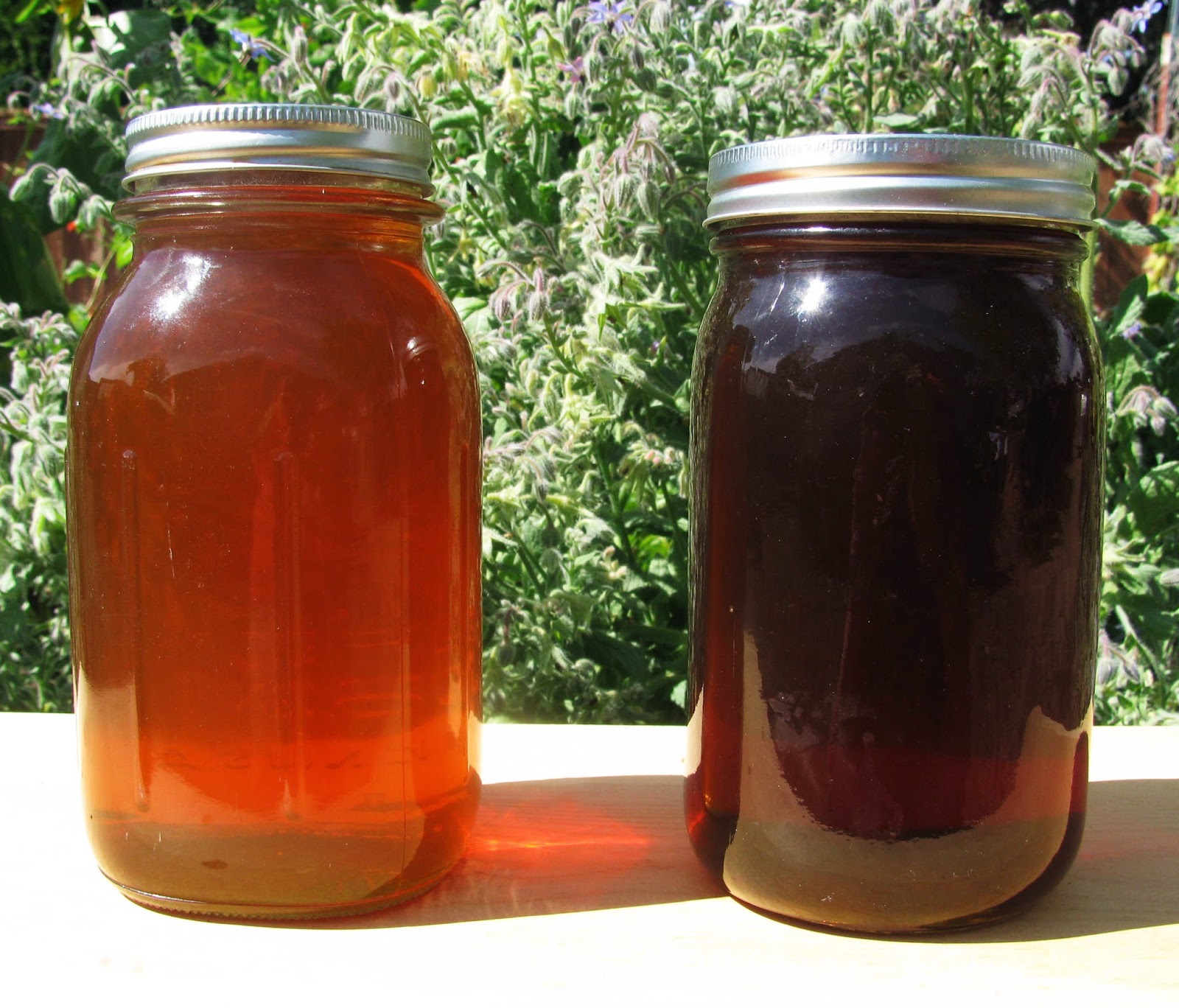
And just like that, you have summer in a bottle.
Labels:
honey,
Karessa Torgerson
Subscribe to:
Posts (Atom)