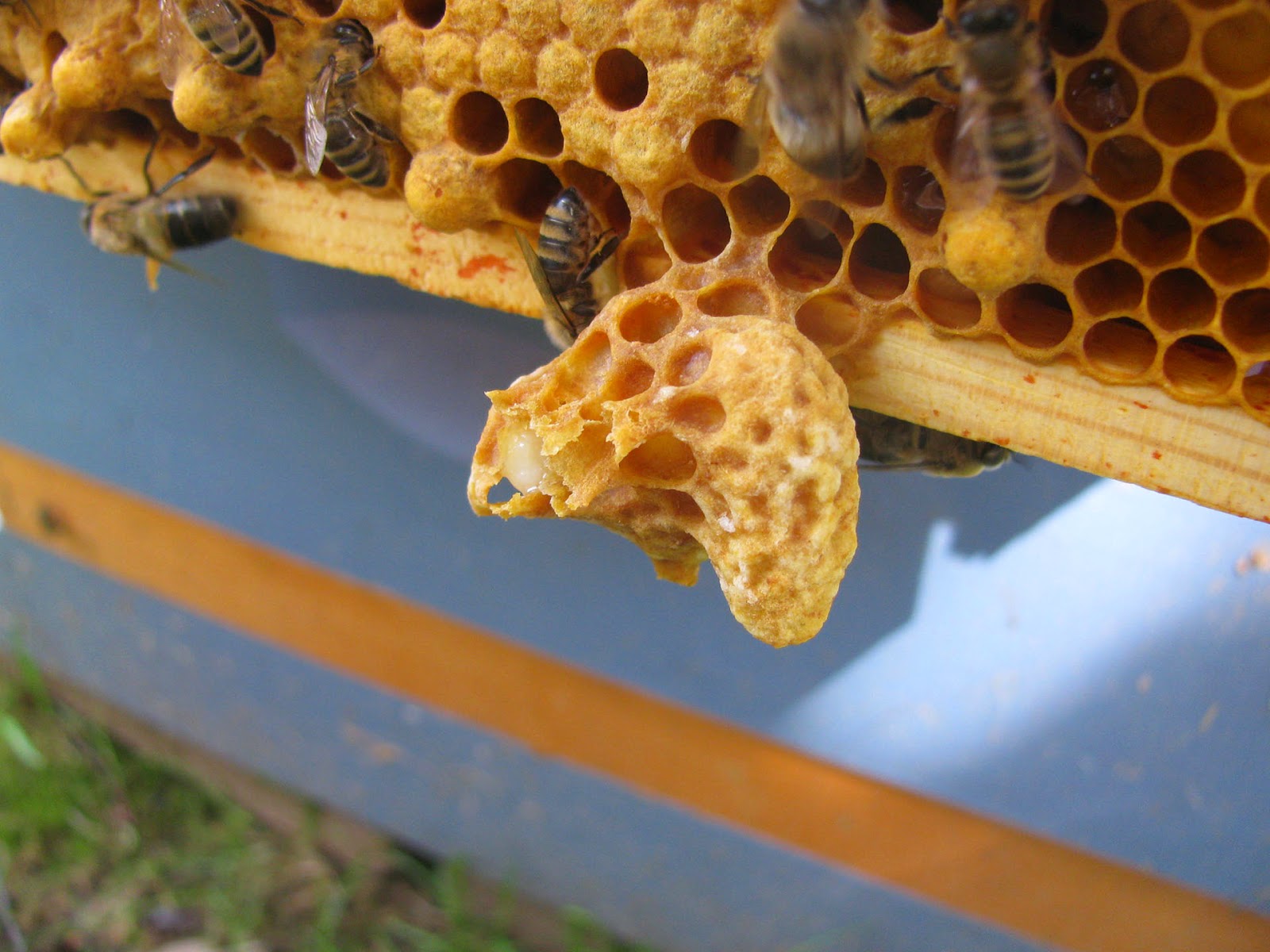
I checked in with my backyard hive the other day, expecting to find them busily working on drawing new foundation and storing nectar. They were doing that (see above), but...
...apparently they are working on some side projects as well. Dang! This is the fancy pants Russian hygienic queen I bought last year. Multiple capped and uncapped swarm cells in the middle brood box (I use all 8 frame westerns).
Here is a queen larvae swimming in a bath of royal jelly. And WOW, my gloves are dirty!
Here is another surprise for me. Look closely...
Multiple varroa mites in a single drone cell. I check the mite board on this hive regularly, and I have counted maybe one mite in the last few weeks. But scrape open the drone cells and it's a different story. This highlights the importance of monitoring and testing for varroa beyond just visual inspections of a mite board.
It's not all doom and gloom though. The bees and brood look good and they are bringing in loads of nectar and pollen. Swarm season is upon us! I hope this queen stays.
Reverie
Reverie - n. a state of being pleasantly lost in one's thoughts; a daydream or fantasy; a visionary or impractical idea
"To make a prairie it takes a clover and one bee,—
One clover, and a bee,
And revery.
The revery alone will do
If bees are few." - Emily Dickinson
Showing posts with label swarms. Show all posts
Thursday, April 10, 2014
Thursday, May 2, 2013
Exodus
Beeman moved his hives to a new location near the McDonald-Dunn Forest. I have a little hive there, too.
...but today they were acting weird. Loitering, even. And there were drones emerging, too.
Then they started pouring out of the hive like liquid, with the most incredible sound you can imagine.
Once in the air they appeared very disorganized. But be patient...
Bees have perfected the art of organized chaos. Eventually a pattern to their movements became evident and I was able to determine which tree they had chosen.
Maybe four or five minutes later, and the entrance is back to normal. Minus a few thousand bees of course. And the queen.
They chose a tree not fifteen feet from their original hive. Just for fun, I wanted to capture Beeman's colony and put it in my own hive. That is way too high though.
So here they rest, clustered tightly around a branch, protecting the queen and weighing their options. To a beekeeper swarms can be a frustration and represent a loss of hive productivity and honey-making potential.
But in terms of the bees it is colony-level reproduction and a sort of cleansing ritual for the hive. I have observed many swarms in flight, but I am still blown away that I was able to see this one come to life.
Wednesday, April 24, 2013
The Virgin Diaries - Part I
This is what I love about beekeeping. You never know what you're going to get when you open a hive. In this case it was virgin queens, and lots of them. Beeman's hives are bursting at the seams, and this one seems a bit restless and unsatisfied.
Swarm cells. Supercedure cells. Cells constructed and then abandoned. Cells ripped apart by an emerging virgin queen. Cells intact housing a virgin queen. This hive doesn't discriminate.
I removed a cell and opened it up out of curiosity. There is the live queen, sitting in waxy darkness waiting to learn her fate. She is small and unmated, with a slender abdomen not yet ready for egg-laying, and she's all mine.
Into a queen cage she goes until we decide where to put her. Imagine being suspended in a cage, in darkness, with thousands of others clamoring for your release, when you'll either be accepted as the future of the hive or killed on the spot. What a game of chance.
This is the swarmy virgin-factory. This hive is literally spilling over with bees. Dripping, buzzing, crowded, restless bees.
I caught another live one just hatching. In the cage you go.
Sidenote: to the beekeeper go the spoils. Always reserve a taste for yourself.
Another nice queen cell. Let's open it and collect another.
By this time the hive has been open for a while.
We ran out of queen cages, so for now they'll live in these jars. When I dream of my perfect bedroom, there is an observation hive in the wall above my bed, and jars like these on shelves.
That dark beauty is a definite keeper. In fact, I may take her with me and make a split from my hive at home. A virgin queen is a gamble - she has to make it out on a mating flight and then back again, but experimentation and a bit of uncertainty are the spark of beekeeping for me.
Beeman has incredible colonies. The swarmy virgin-factory is one of his.
In all, we gathered six new queens from that hive that were healthy and strong enough to save. Two are going with me, and four are co-habiting this nuc for the time being (two in cages and two unhatched cells).
Sunday, July 8, 2012
Beeman Gets Another Swarm
These hives belong to my mentor, Beeman. The hive with the orange box contains the swarm he caught in May. Beautiful boxes, beautiful setting...
...and beautiful swarm about fifty feet behind them in the orchard next to Rainshine Family Farm. Yes, another swarm - he seems to attract them. This one was about twelve feet up in a fruit tree.
Empty hive boxes were placed under the tree to try to lure the swarm down.
Aren't they incredible?
And now there are six!
...and beautiful swarm about fifty feet behind them in the orchard next to Rainshine Family Farm. Yes, another swarm - he seems to attract them. This one was about twelve feet up in a fruit tree.
Empty hive boxes were placed under the tree to try to lure the swarm down.
And now there are six!
Tuesday, June 12, 2012
The Swarm Catchers
I am such a lucky girl. The other evening Beeman got a call that his friends Tim and Mary found a swarm on their land that was in an easy location for capturing. They have an amazing farm on the Marys River not far from my house. In addition to being great models of self-sufficient living, they are beekeepers with eleven hives (I'm jealous)!
I love how swarms always seem to find their way to the properties of people who deserve them the most.
Mary and Tim are getting ready to shake and brush the swarm into an empty hive box. When bees are clustered in a swarm they are extremely gentle. Their only concern is staying together and protecting the queen. Everything is calm and lovely...
...and now it is not. Beeman, Mary, and Tim stirring up the bees and creating a wonderful scene of chaos.
The hive box was left up on the ladder for awhile to encourage more bees to go inside.
Most of the bees were contained within the hive box, but a large number were bearding on the front near the entrance.
A group of bees immediately assumed guard duty, lifting their abdomens in the air and fanning their wings to signal that a suitable home had been found. Usually this is a good sign that the queen is inside with them.
There were some stragglers left on the arbor. They will most likely join their sisters in the new hive soon. I don't know that I would like to be forceably told where to go either. Some bees are stubborn, just like me.
Not even 30 minutes later, the bees had all moved inside the hive. The next steps for Tim and Mary are to add additional frames to the hive and inspect the bees in a few days to verify that a queen is indeed inside. And now they have twelve active hives (super jealous). Twelve!!!
In addition to beekeeping, Mary also breeds carnivorous plants. Two very exciting hobbies, don't you think? Thank you for an incredible evening!
In other news, yesterday I found a swarm of my own. Melanie and I were walking with the boys near the Oak Creek covered bridge when a cloud of thousands of bees surrounded us, moving very slowly through the forest. We watched them settle and cluster on an old tree, practically hidden from view.
I completely understand the allure of catching a swarm in order to expand your hives, but there is something magical about a swarm that is able to establish itself in the wild. Don't worry bees, your secret is safe with me.
Wednesday, June 6, 2012
The Feral Queen Revisited
Here we are taking a peek at the swarm I wrote about in an earlier post. The once-feral queen is alive and well. Can you spot her? Look at that beautiful frame she has created - a tight brood pattern and radiating bands of pollen and honey. This is what you want in your hive.
Here is a closer view. Notice the dutiful attendants surrounding her.
To help prevent a hive from swarming, capped queen cells are usually removed. Here are some destroyed cells with larvae inside.
Hello, sir. The drones are noticeably larger than the females, with enormous eyes to assist them on their mating flights. These guys are hanging around hoping they will get to do just that.
This is a mite-trapping frame like the one's designed by Randy Oliver. The top 2" or so of the frame is used by the bees to store honey, and the bottom is filled with drone cells. Varroa mites prefer the larger size of drone cells, and once these cells are capped the comb can be scraped out and fed to your chickens. The honey in the top can be returned to the bees (maybe) or cut out and eaten as comb honey (yes, please).
I would like to try this type of frame in my hives. Maybe my mentor will build me one (hint, hint).
A parting shot. Look at the amount of energy stored in those cells!
Subscribe to:
Posts (Atom)